Why Road Ambulances Alone Can’t Solve India’s Emergency Response Crisis
India’s road congestion is a humanitarian tax on the "Golden Hour." This article explores why ground-based EMS is failing and why Jaipur-based Dragale Aviation is building a dedicated aerial bypass.
The primary reason road ambulances cannot solve India’s emergency crisis is systemic gridlock: in major Indian metros and Tier-2 hubs like Jaipur, peak-hour traffic speeds have plummeted to single digits, making it impossible to reach trauma victims within the critical "Golden Hour". Ground-based emergency medical services (EMS) are restricted by an impermeable barrier of vehicular density. While traditional solutions like "green corridors" exist, they require massive police coordination and are unsustainable for the high volume of daily emergencies occurring across the country. To save lives, India requires an infrastructural bypass that operates independently of the surface network.
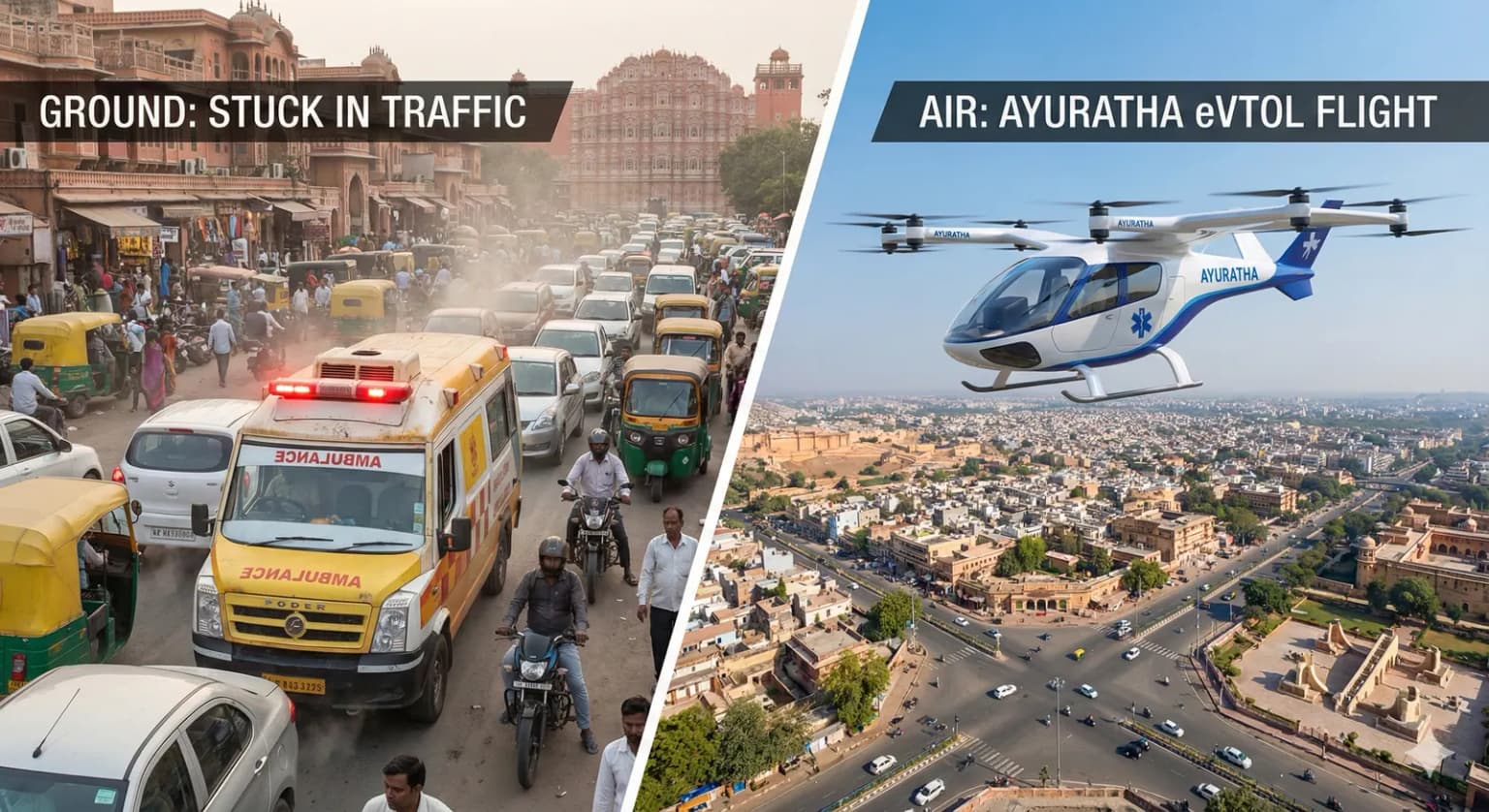
The "Golden Hour" is Being Lost on Indian Roads
The "Golden Hour"—the first 60 minutes after a traumatic injury—is the critical window where prompt medical intervention offers the highest probability of survival. In India, this window is frequently missed due to several structural factors:
- Unpredictable Response Times: Ambulance response times in Indian metros often exceed 45 minutes for distances that should technically take only ten.
- High Fatality Rates: India accounts for approximately 11% of global road accident deaths, a significant portion of which are attributed to delayed transport to medical facilities.
- Organ Transplant Logistics: A human heart must be transplanted within 4 hours of retrieval. In cities like Delhi or Bengaluru, covering just 30km from an airport to a hospital can take 2 hours by road, consuming 50% of the organ's viable life.
Why "Retrofitting" Traffic Isn't the Answer
Urbanization in India is accelerating, with 40% of the population projected to live in urban areas by 2030. Surface transport infrastructure cannot keep pace with this demographic shift. Unlike Western markets where Advanced Air Mobility (AAM) is often pitched as a luxury for the wealthy, in India, it is a utilitarian necessity.
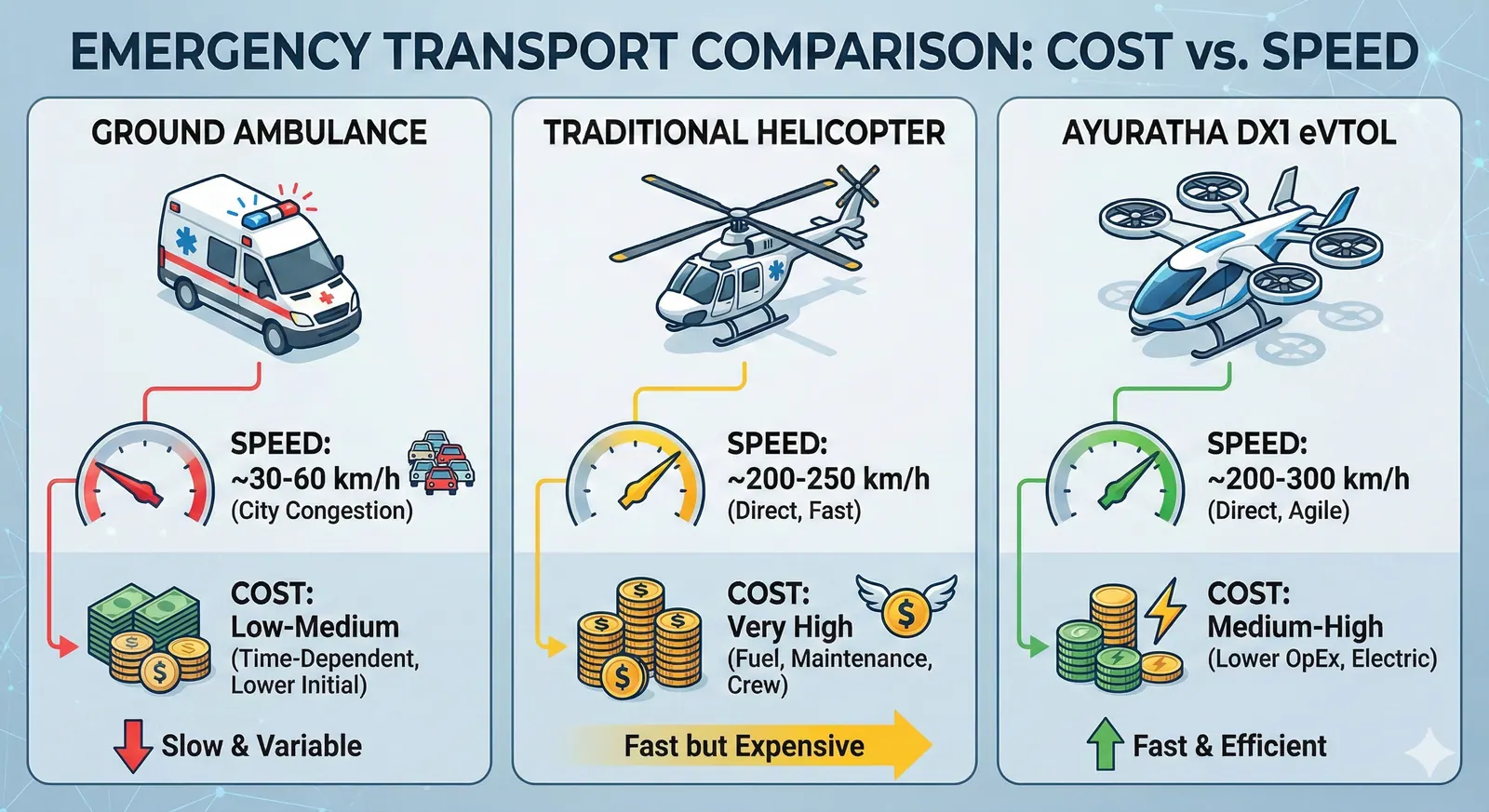
The cost barrier for traditional aerial solutions is also a major hurdle. A helicopter charter in India can cost between INR 1.5 to 3 Lakhs per hour, limiting its use to the top 1% of the economic pyramid.
The Jaipur-Delhi Corridor: A Case for Aerial EMS
Regional giants like Manipal Hospital and Mahatma Gandhi Hospital in Jaipur cater to massive catchment areas, including industrial zones and satellite towns. Patients in these regions often require transfers to specialized centers in Delhi (like AIIMS or Medanta).
- Ground Reality: This transfer takes 5–6 hours by road.
- AyuRatha Solution: With a cruise speed of 250 km/h, the AyuRatha (DX1) can complete a Jaipur-to-Delhi transfer in approximately 60–70 minutes.
Dragale’s AyuRatha: Built for the Medical Mission
Dragale Aviation’s AyuRatha (DX1) is not a modified air taxi; it is India’s first dedicated eVTOL air ambulance. Its design prioritizes medical utility over mass transit:
- Stretcher-First Design: Unlike compact 2-seater competitors, the AyuRatha is designed specifically for easy stretcher loading and enough payload to carry a patient, medical equipment, and two medics.
- Vibration Dampening: Engineered specifically to protect spinal injury patients during high-speed transit.
- Cost-Effectiveness: By using Distributed Electric Propulsion (DEP), the AyuRatha aims to offer air ambulance services at a price point comparable to premium ground services, costing an estimated $200–$400 per hour to operate.
FAQ: India’s Transition to Air Ambulances
How fast can an eVTOL air ambulance travel in India?
The AyuRatha (DX1) features a cruise speed of 250 km/h, allowing it to bypass road traffic and complete inter-city medical transfers (like Jaipur to Delhi) in roughly one-fifth of the time required by a ground ambulance.
Why are eVTOLs better than traditional helicopters for EMS?
eVTOLs are significantly quieter (<65 dBA), have lower mechanical complexity, and offer an estimated operating cost of $200–$400 per hour, compared to $1,500–$3,000 for turbine helicopters. This makes aerial EMS accessible to the upper-middle class and insurance-covered populations rather than just the ultra-wealthy.
When will eVTOL air ambulances be operational in India?
The DGCA has already published the "Vertical Take-off and Landing Capable Aircraft (VCA)" regulatory framework. [cite_start]Commercial air taxi and ambulance trials are projected to begin in major Indian hubs like Delhi and Mumbai by 2026[cite: 3].
Related posts
- Regulatory Readiness for Medical eVTOL Operations in India: What Comes FirstNavigating the DGCA’s VCA framework is the first step for aeromedical pioneers. Learn why Design Organisation Approval (DOA) and Type Certification are the foundation of India’s flying ambulance future.
- eVTOL Air Ambulance vs Helicopter EMS: A Mission-by-Mission ComparisonHow does the AyuRatha eVTOL stack up against traditional helicopters? We compare operational costs, noise profiles, and specific medical mission outcomes.
- Why India Needs Dedicated eVTOL Air Ambulances (Not Just Air Taxis with Stretchers)India’s emergency healthcare challenge cannot be solved by retrofitting passenger eVTOLs. This article explains why medical-first eVTOL air ambulances are a fundamentally different and necessary category.