Why India Needs Dedicated eVTOL Air Ambulances (Not Just Air Taxis with Stretchers)
India’s emergency healthcare challenge cannot be solved by retrofitting passenger eVTOLs. This article explains why medical-first eVTOL air ambulances are a fundamentally different and necessary category.
India’s Emergency Care Problem Is a Time Problem
In medical emergencies, outcomes are often determined not by what treatment is given, but how fast it begins.
For cardiac arrest, stroke, severe trauma, and organ failure, the golden hour is not a metaphor—it is a measurable survival window.
In India, this window is routinely lost due to:
- Urban congestion that turns short distances into hour-long journeys
- Limited availability of trauma-ready hospitals outside metros
- Geographic barriers in hilly, coastal, and remote regions
Road ambulances, no matter how well-equipped, are fundamentally constrained by ground infrastructure. Helicopter ambulances help, but they are expensive, scarce, noisy, and operationally complex.
This gap is where electric Vertical Take-Off and Landing (eVTOL) aircraft are often proposed as the solution. But an important question is rarely asked:
What kind of eVTOL is actually suitable for emergency medicine?
The Dangerous Assumption: “Any eVTOL Can Become an Ambulance”
Most eVTOL aircraft being developed today are designed primarily for passenger mobility—urban air taxis meant to move people quickly between predefined locations.
The assumption many make is simple:
“If it can carry passengers, it can carry a patient.”
From an engineering and medical standpoint, this assumption is flawed.
Passenger eVTOLs are optimized for:
- Seat count and cabin density
- Ride comfort and noise reduction
- Cost per passenger-kilometer
- Scheduled, predictable flight paths
Emergency medical transport is optimized for something entirely different:
- Patient stability under stress
- Medical crew ergonomics
- Equipment redundancy
- Unpredictable dispatch and routing
- Zero tolerance for in-flight system failure
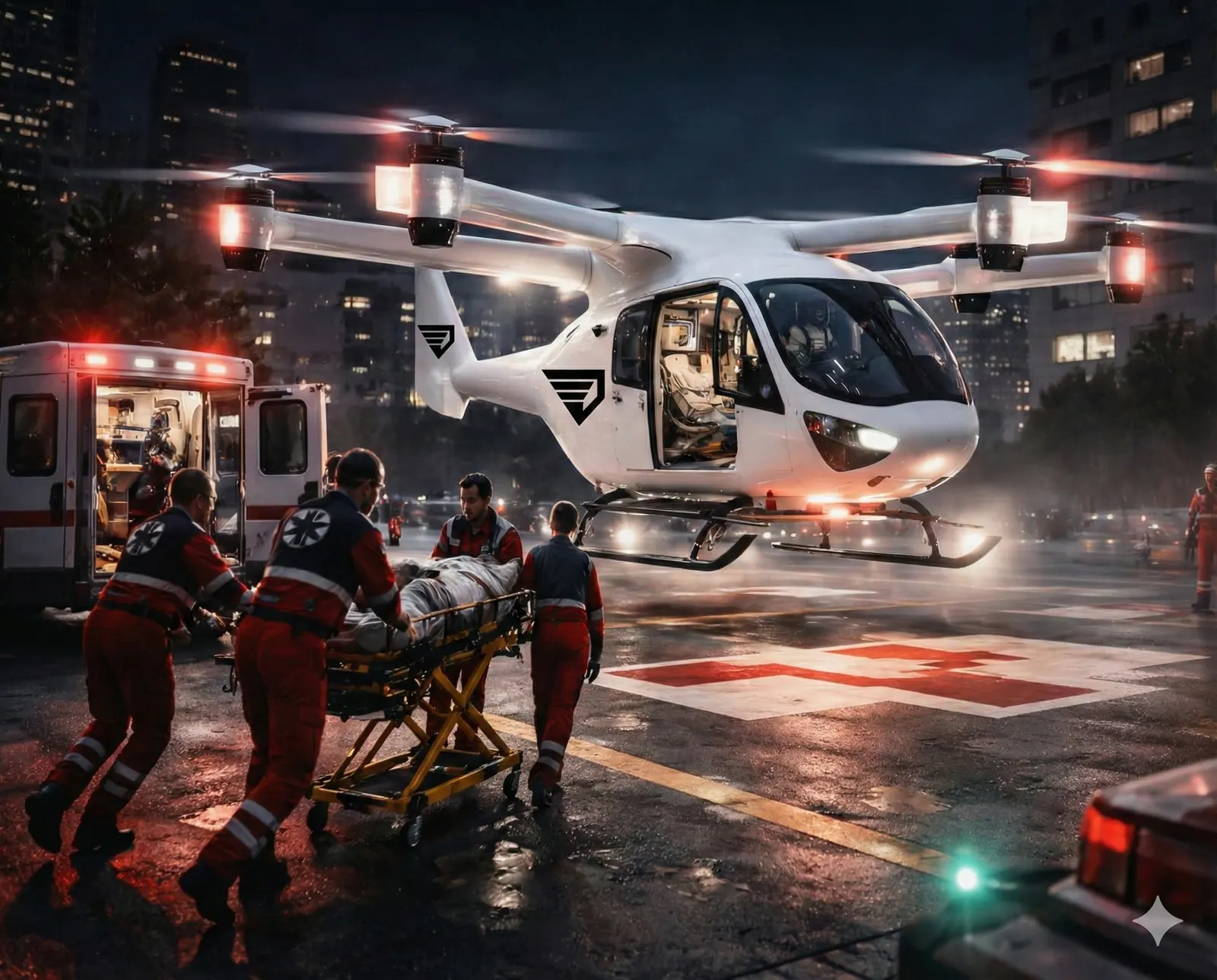
An air ambulance is not a flying car.
It is closer to a flying intensive care unit.
What Actually Makes an Aircraft a True Air Ambulance
A dedicated eVTOL air ambulance must be designed around the patient, not adapted for them later.
1. Cabin Architecture: Stretcher-First, Not Seat-First
In emergency transport:
- The stretcher is the primary payload
- Medical staff must be able to access the patient from multiple sides
- Equipment placement must allow in-flight intervention
Retrofitting stretchers into passenger cabins often compromises:
- Crew movement
- Equipment mounting safety
- Emergency procedures during turbulence or hard landings
A medical-first eVTOL designs the cabin starting with the stretcher, not trying to fit one in later.
2. Mission Profile: Urgency Over Optimization
Passenger eVTOLs assume:
- Known routes
- Known take-off and landing points
- Scheduled or semi-scheduled operations
Emergency missions assume:
- Unplanned dispatch
- Variable landing sites (hospital rooftops, temporary pads)
- Rapid turnaround under pressure
This changes how power systems, flight controls, and redundancy are designed. In medical aviation, predictability and reliability matter more than maximum range or top speed.
3. Systems Redundancy: Medical Risk Tolerance Is Different
For a passenger aircraft, delays are inconvenient.
For a medical aircraft, delays can be fatal.
Dedicated air ambulances prioritize:
- Redundant power and avionics
- Stable flight profiles that minimize vibration
- Systems designed to fail safely, not just efficiently
These design priorities often conflict with ultra-lightweight, cost-optimized passenger designs.
Why India’s Context Makes Medical-First Design Essential
India is not a scaled-down version of Western urban air mobility markets. It is a fundamentally different operating environment.
Key realities include:
- High population density with uneven hospital distribution
- Rapidly growing Tier-2 and Tier-3 cities
- Long inter-city travel times for advanced care
- Strong public-health need but cost sensitivity
In this context, deploying eVTOLs first as luxury air taxis risks misallocating a technology that could save lives immediately.
India does not primarily need “Uber in the sky.”
It needs emergency healthcare infrastructure in the sky.
What Hospitals and Operators Should Demand from eVTOL Ambulances
As interest in aerial medical transport grows, hospitals and operators should evaluate partners carefully.
A few non-negotiables:
- Medical-first aircraft design, not passenger retrofits
- Clear regulatory and certification roadmap
- Integration with existing emergency workflows
- Pilot programs before large-scale commitments
- Transparent operating assumptions and limitations
Choosing the wrong platform early can lock institutions into years of operational compromise.
The Future of Emergency Mobility Will Be Built Around Medicine
eVTOL technology has the potential to redefine emergency response in India—but only if it is deployed with the right priorities.
Just as CT scanners, cath labs, and trauma centers became standard healthcare infrastructure, dedicated aerial emergency mobility will become part of India’s medical backbone.
The future will not be shaped by who flies first for headlines,
but by who designs first for patients.
Related posts
- Regulatory Readiness for Medical eVTOL Operations in India: What Comes FirstNavigating the DGCA’s VCA framework is the first step for aeromedical pioneers. Learn why Design Organisation Approval (DOA) and Type Certification are the foundation of India’s flying ambulance future.
- Why Road Ambulances Alone Can’t Solve India’s Emergency Response CrisisIndia’s road congestion is a humanitarian tax on the "Golden Hour." This article explores why ground-based EMS is failing and why Jaipur-based Dragale Aviation is building a dedicated aerial bypass.
- eVTOL Air Ambulance vs Helicopter EMS: A Mission-by-Mission ComparisonHow does the AyuRatha eVTOL stack up against traditional helicopters? We compare operational costs, noise profiles, and specific medical mission outcomes.