eVTOL Air Ambulance vs Helicopter EMS: A Mission-by-Mission Comparison
How does the AyuRatha eVTOL stack up against traditional helicopters? We compare operational costs, noise profiles, and specific medical mission outcomes.
The fundamental difference between eVTOL air ambulances and traditional Helicopter EMS (HEMS) lies in accessibility and operational efficiency: eVTOLs like the AyuRatha (DX1) reduce operational costs by nearly 90% and noise levels by 20 dBA, enabling landing in dense urban areas where helicopters are often restricted. While helicopters remain the gold standard for high-altitude or long-range wilderness rescues, eVTOLs are the superior choice for the "urban-to-hospital" and "inter-hospital" medical logistics that define the Indian healthcare gap.
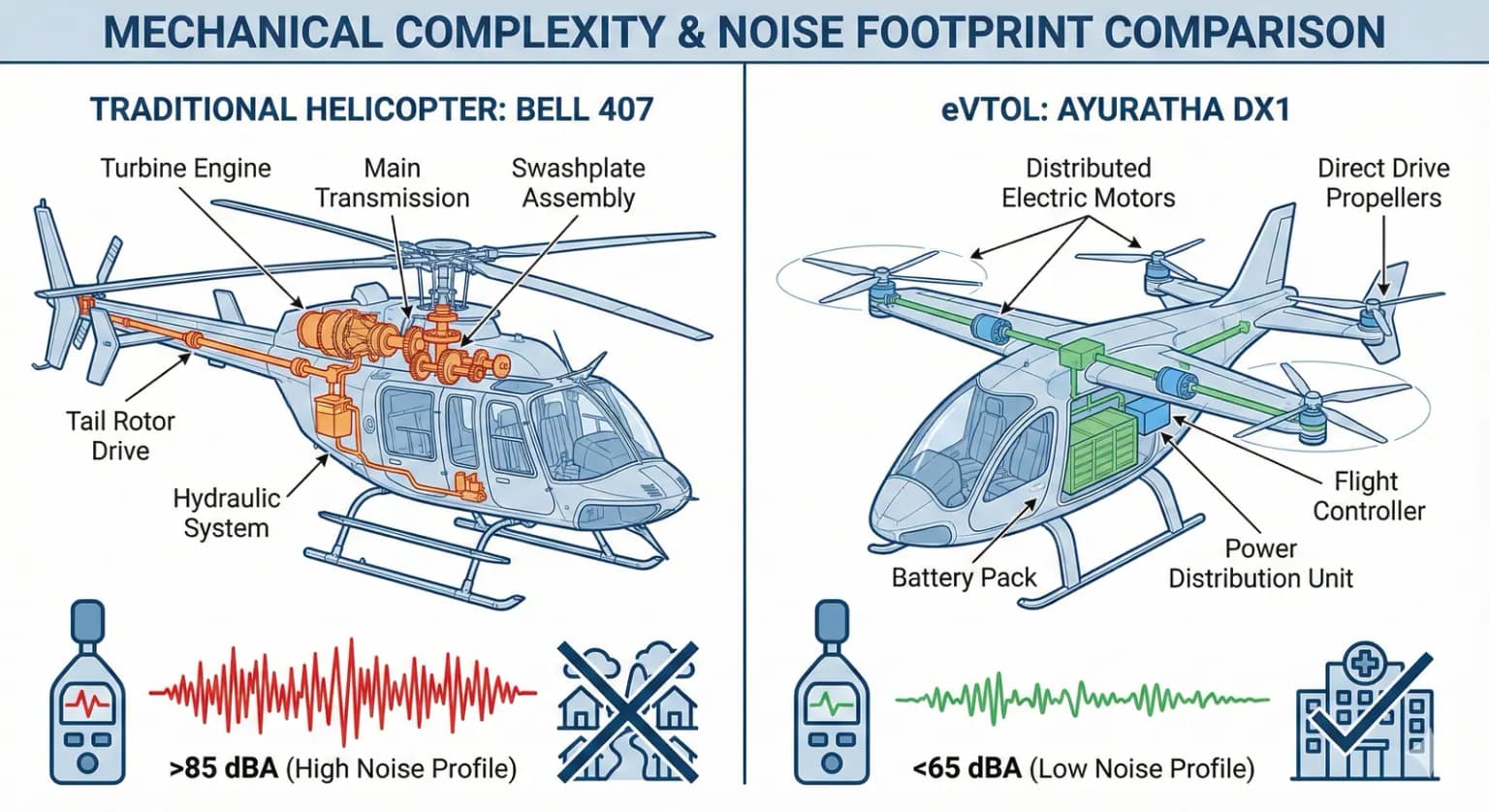
Comparison at a Glance: The Data
The shift from turbine-powered flight to Distributed Electric Propulsion (DEP) changes the economic logic of medical aviation.
| Metric | Turbine Helicopter (e.g., Bell 407) | AyuRatha DX1 (eVTOL) |
|---|---|---|
| OpEx Per Hour (Est.) | $1,500 – $3,000 | $200 – $400 |
| Noise Profile | High (>85 dBA) | Low (<65 dBA) |
| Mechanical Complexity | High (Single points of failure) | Low (Direct drive motors) |
| Infrastructure | Helipad + Fueling Truck | Vertiport + Charging Station |
| Payload Capacity | Variable | Dedicated Medical Suite |
Mission Profile 1: Organ Transport (The "Time-Critical" Race)
In organ transplant logistics, the "cold ischemia time" is the primary enemy. A heart, for instance, must be transplanted within 4 hours.
- The HEMS Challenge: Helicopters are often barred from landing near dense urban residential zones at night due to noise pollution. This necessitates a "Road-Air-Road" chain that eats into the 4-hour window.
- The AyuRatha Advantage: With a noise profile of <65 dBA, the AyuRatha can operate in urban environments with minimal disruption. It eliminates the "last-mile" ground transfer by landing directly on hospital rooftops or nearby parking zones.
Mission Profile 2: Inter-Hospital Transfers (Jaipur to Delhi)
Patients in Tier-2 cities like Jaipur often need transfer to specialized centers in Delhi for advanced cardiac or trauma care.
- The HEMS Challenge: High charter costs (up to INR 3 Lakhs per hour) make this service accessible only to the top 1%.
- The AyuRatha Advantage: By lowering the cost of flight to a price point comparable to premium ground ambulances, the AyuRatha democratizes access for the upper-middle class and insurance-covered patients. It covers the Jaipur-Delhi corridor in ~60-70 minutes, compared to 5-6 hours by road.
Mission Profile 3: Urban Trauma Response
For road accidents in gridlocked metros, every minute spent in transit increases the risk of mortality.
- The HEMS Challenge: Large rotor diameters and downwash make it dangerous to land near many crash sites or smaller private hospitals.
- The AyuRatha Advantage: Its Lift + Cruise architecture allows for precise, compact vertical landings. Furthermore, the AyuRatha is designed with a "Stretcher-First" cabin layout, ensuring that medics can begin intervention the moment the patient is loaded.

FAQ: Choosing the Right Medical Modality
Is an eVTOL safer than a traditional helicopter for patients?
Yes, in several ways. eVTOLs utilize Distributed Electric Propulsion (DEP), meaning they have multiple independent motors and battery packs. If one motor fails, the others can maintain flight, whereas a helicopter often relies on a single complex transmission and rotor system.
Can the AyuRatha carry the same medical equipment as a helicopter?
The AyuRatha DX1 is designed with an "Advanced Medical Suite" that includes onboard power for ventilators, monitors, and specialized equipment. While some helicopters have larger payloads, the AyuRatha is specifically optimized for the weight of a standard medical team and life-support systems.
Does the AyuRatha require a specialized pilot?
While helicopters require a specialized Commercial Pilot License (CPL-H), the DGCA has recognized eVTOLs as a distinct category. Pilots will operate under a simplified "Powered Lift License," leveraging fly-by-wire systems that reduce the cognitive load and potential for human error during medical emergencies.
Related posts
- Regulatory Readiness for Medical eVTOL Operations in India: What Comes FirstNavigating the DGCA’s VCA framework is the first step for aeromedical pioneers. Learn why Design Organisation Approval (DOA) and Type Certification are the foundation of India’s flying ambulance future.
- Why Road Ambulances Alone Can’t Solve India’s Emergency Response CrisisIndia’s road congestion is a humanitarian tax on the "Golden Hour." This article explores why ground-based EMS is failing and why Jaipur-based Dragale Aviation is building a dedicated aerial bypass.
- Why India Needs Dedicated eVTOL Air Ambulances (Not Just Air Taxis with Stretchers)India’s emergency healthcare challenge cannot be solved by retrofitting passenger eVTOLs. This article explains why medical-first eVTOL air ambulances are a fundamentally different and necessary category.